Technical Specification Guide for AS/NZS 2802 Trailing Cables in Bulk Material Handling
AS/NZS 2802 散料处理拖缆技术规范指南
Anhui Feichun Special Cable Co., Ltd. 安徽飞纯特种电缆有限公司
What Are the Requirements for Type 409 Cables Used in Stacker-Reclaimer Systems?
Technical Specification Guide for AS/NZS 2802 Trailing Cables in Bulk Material Handling AS/NZS 2802 散料处理拖缆技术规范指南
Introduction 简介
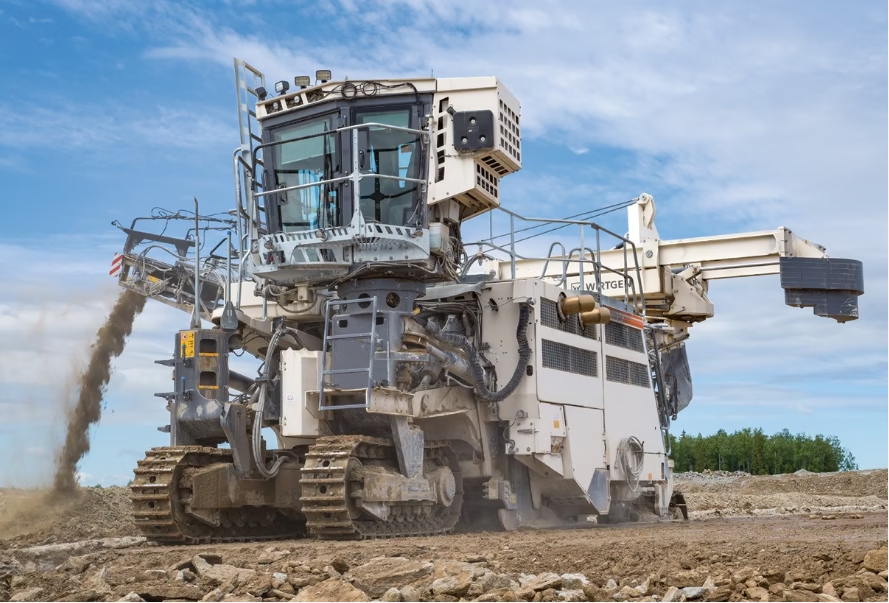
Stacker-reclaimer systems represent essential infrastructure in bulk material handling operations across coal terminals, iron ore facilities, grain elevators, and aggregate stockyards. According to Wikipedia’s technical documentation, reclaimers are large machines used in bulk material handling applications whose function is to recover bulk material such as ores and cereals from stockpiles. These machines normally travel on rails between stockpiles in the stockyard and are generally electrically powered by means of trailing cables. A bucket wheel reclaimer can typically move in three directions: horizontally along the rail, vertically by luffing its boom, and rotationally by slewing its boom.
Type 409 cables, manufactured to AS/NZS 2802:2000, serve as a principal cable solution for stacker-reclaimer installations where metallic screening, high flexibility, and robust mechanical protection are required. This technical guide examines the specific requirements for Type 409 cables in stacker-reclaimer applications, covering construction specifications, electrical parameters, mechanical considerations, and regulatory compliance based on authoritative industry sources.
Understanding Stacker-Reclaimer Cable Requirements 了解堆取料机电缆要求
Stacker-reclaimers perform dual functions in stockyard operations. According to Coal Handling Plants technical documentation, rail-mounted stacker-reclaimers are suitable for serving two parallel stockpiles, one on either side of the track rails. The stacking operation involves the boom conveyor carrying material and allowing it to fall onto a stockpile, whilst reclaiming operations involve rotating bucket wheels that swing across the pile to remove material in layers.
The cable requirements for these systems differ from underground coal mining applications due to specific operational characteristics. Cables must withstand extended travel distances (frequently exceeding 500-800 metres), continuous duty cycles often exceeding 20 hours daily, outdoor environmental exposure including solar radiation and weather, and significant mechanical stress from dragging and lateral movement across operational areas.
Critical Operational Demands on Stacker-Reclaimer Cables 堆取料机电缆的关键运行要求
Travel Distance: Frequently exceeding 500-800 metres, requiring long cable runs without excessive voltage drop or pilot resistance issues.
Duty Cycle: Continuous operation often exceeding 20 hours per day, demanding exceptional durability and thermal stability.
Mechanical Stress: Constant dragging and lateral movement across operational areas subjects cables to abrasion, tensile loading, and potential impact damage.
Environmental Exposure: Direct exposure to solar radiation, weather, dust, moisture, and temperature extremes requires superior material resistance.
Type 409 Cable Construction Specifications Type 409 电缆构造规格
According to Eland Cables technical documentation, Type 409 cables are designed for the Australian and New Zealand mining industry as a feeder cable solution for installations requiring a high degree of flexibility. The cable has applications across dynamic mining machinery such as pumps, drills, shovels and also in smaller applications such as handheld tools and equipment. The cable configuration sees three power cores assembled on a cradle around a single pilot core.
| Component | Material / Specification | Function |
|---|---|---|
| Conductor 导体 | Flexible stranded tinned annealed copper | Primary current-carrying element; tinning provides corrosion resistance |
| Conductor Screen 导体屏蔽 | 1.1kV: Polyester barrier tape 3.3kV and above: Polyester barrier tape + extruded semiconductive tape |
Eliminates air voids; ensures uniform electric field distribution |
| Insulation 绝缘层 | EPR (Ethylene Propylene Rubber) Type R-EP-90 | Primary electrical insulation; rated 90°C continuous operation |
| Insulation Screen 绝缘屏蔽 | Semiconductive tape / semiconductive elastomer | Provides defined earth potential surface for fault detection |
| Composite Screen (Earth) 复合屏蔽(接地) | Tinned annealed copper braiding interwoven with polyester yarn | Earth fault current path; phase identification via coloured tracers |
| Cradle Separator 托架分隔层 | Semiconductive PCP | Core support and protection; maintains geometric stability |
| Central Pilot 中心引导芯 | EPR covered flexible stranded tinned copper | Earth continuity monitoring; provides structural reinforcement |
| Sheath Reinforcement 护套增强层 | Polyaramid (Kevlar®) yarn braid (cables ≥50mm² except 409.1) | Exceptional tear and cut-through resistance |
| Outer Sheath 外护套 | Heavy-duty PCP (HD-PCP) or HD-85-PCP | Mechanical protection; flame retardant; UV/ozone/oil resistant |
According to Prysmian Australia’s Mining Cable Guide, all Type 409 cables (except 409.1 below 50mm²) incorporate a polyaramid yarn Kevlar® braid sheath reinforcement for exceptional tear and cut-through resistance. This enhancement provides crucial protection in stacker-reclaimer applications where cables experience significant mechanical stress during trailing operations. The Kevlar® fibre reinforcement enhances the sheath’s mechanical strength and improves resistance against damage from crushing, stretching, and tear propagation.
Voltage Rating Requirements 额定电压要求
Type 409 cables are available across multiple voltage ratings to accommodate various stacker-reclaimer power requirements. According to Eland Cables specifications, the Type 409 cable conforms to AS/NZS 1125:2001 and AS/NZS 2802:2000 standards with voltage ratings of 1.1kV, 3.3kV, 6.6kV, 11kV, and 22kV.
| Designation | Voltage Rating (Uo/U) | Typical Application |
|---|---|---|
| Type 409.1 | 1.1/1.1 kV | Small equipment; hand-held tools; auxiliary systems |
| Type 409.3 | 3.3/3.3 kV | Medium-duty stacker-reclaimers; conveyor drives |
| Type 409.6 | 6.6/6.6 kV | Large stacker-reclaimers; draglines; shovels |
| Type 409.11 | 11/11 kV | High-capacity equipment; extended cable runs |
| Type 409.22 | 22/22 kV | Very large draglines; high-power installations |
Mechanical and Environmental Requirements 机械和环境要求
Flexibility Requirements 柔韧性要求
Stacker-reclaimer cables must possess high-flex design characteristics to handle constant bending and movement as equipment travels along rail tracks. According to Prysmian documentation, Type 409 is a heavy-duty cable with good flexibility and high resistance to abrasion and weathering, suitable for pumps, shovels, draglines, and blast hole drills. The minimum bending radius specification must be observed during drum winding and unwinding operations, typically 6-8 times the cable’s overall diameter.
Trailing vs Reeling Considerations 拖缆与卷绕考虑因素
According to Caledonian Cables and Cable Distribution Services technical documentation, Type 409 series cable is mainly used as a flexible feeder to machinery and is more suitable as a trailing cable rather than for reeling. Smaller cables are used for drills and hand-held tools and equipment, whilst larger ones are used for power supply to draglines, shovels, and drills. The cable includes a central semiconductive cradle for support and protection of power cores.
For stacker-reclaimer systems requiring frequent high-speed reeling operations, alternative cable types such as Type 450 or Type 455 with reduced diameter construction may prove more suitable. According to Caledonian Cables, Type 455 cables are designed with reduced insulation and sheath thickness, no cradle, 2 earth and 1 pilot core in the outer interstices, making them particularly suited to stacker-reclaimer applications where minimal diameter and mass is desired.
| Property | Rating | Stacker-Reclaimer Relevance |
|---|---|---|
| Flame Retardant 阻燃性 | Fire retardant per AS/NZS 2802 | Essential for safety compliance in industrial environments |
| Water Resistance 防水性 | Water resistant / Immersion capable | Withstands rain, flooding, and wash-down operations |
| Chemical Exposure 耐化学性 | Very good / Frequent exposure tolerance | Resists oils, fuels, and industrial chemicals |
| Mechanical Impact 机械冲击 | Heavy duty rated | Critical for trailing operations across rough terrain |
| UV/Solar Radiation 紫外线/太阳辐射 | Suitable for direct exposure | Essential for outdoor stockyard operations |
| Ozone Resistance 耐臭氧性 | Ozone resistant | Prevents surface cracking in outdoor installations |
| Oil Resistance 耐油性 | Oil resistant | Protects against hydraulic fluid and lubricant exposure |
Earth Continuity and Pilot Core Requirements 接地连续性和引导芯要求
Earth continuity protection is a critical safety requirement for stacker-reclaimer trailing cables. The central extensible pilot in Type 409 cables serves dual functions: providing mechanical reinforcement and enabling earth continuity monitoring. For extended cable runs typical in stacker-reclaimer applications (500+ metres), pilot resistance becomes a critical consideration.
Pilot Core Specifications 引导芯规格
Construction: EPR covered flexible stranded tinned copper conductor positioned in the centre of cable assembly.
Maximum DC Resistance: ≤ 5.5 Ω/100m for power cores to 35mm²; ≤ 3.0 Ω/100m for power conductors above 35mm².
Function: Provides earth continuity monitoring capability and structural reinforcement for extended cable runs.
Alternative Configuration: For very long cable runs where Type 409 pilot resistance may not meet requirements, Type 440 cables with three pilot cores are recommended to ensure adequate protection system functionality.
According to Prysmian documentation, Type 440 cables are suitable for long lengths of cable runs in cases where the use of Type 409 or 441 could result in pilot resistances not meeting requirements. Having three pilots, the cable can be used in long runs without compromising pilot control protection system resistance limitations.
Cable Type Selection for Stacker-Reclaimer Applications 堆取料机应用电缆类型选择
Understanding when Type 409 is the optimal choice versus alternative AS/NZS 2802 cable types helps ensure proper specification for stacker-reclaimer applications. Each cable type offers distinct advantages depending on specific operational requirements.
| Cable Type | Screen Type | Pilots | Best Application | Stacker-Reclaimer Suitability |
|---|---|---|---|---|
| Type 409 | Composite metallic (Cu braid) | 1 central | Trailing to draglines, shovels, drills | Good — trailing applications; moderate cable lengths |
| Type 440 | Composite metallic (Cu braid) | 3 interstitial | Extended runs requiring low pilot resistance | Excellent — long runs (500m+); reeling and trailing |
| Type 441 | Semiconductive elastomer | 3 interstitial | Materials handling; smaller diameter needed | Good — Kevlar® reinforced; slow reeling |
| Type 450 | Composite metallic (Cu braid) | 3 interstitial | Reduced diameter; lightweight trailing | Excellent — draglines, shovels, excavators, wharf cranes |
| Type 455 | Semiconductive elastomer | 1 pilot + 2 earth | Minimal diameter; stacker-reclaimer optimised | Excellent — specifically designed for stacker-reclaimers |
When to Select Type 409 for Stacker-Reclaimers 何时为堆取料机选择 Type 409
Type 409 is most appropriate for stacker-reclaimer applications when metallic composite screening is required for enhanced EMI shielding or specific regulatory requirements, when cable runs are moderate (typically under 400-500 metres where pilot resistance remains within acceptable limits), and when trailing rather than continuous reeling operation is the primary mode. For applications involving frequent high-speed reeling, Type 450 or Type 455 with optimised reduced diameter construction may prove more suitable due to their lower mass and improved fatigue resistance in repetitive bending applications.
Installation and Operational Requirements 安装和运行要求
Cable Drum and Reel Considerations 电缆卷筒考虑因素
When stacker-reclaimers move along their travel rails, trailing cables are either deployed or recovered onto cable reels fitted to the equipment. According to multiple manufacturer specifications, minimum bending radius requirements must be strictly observed during drum winding and unwinding to prevent conductor damage and insulation stress. The recommended minimum bending radius for Type 409 cables is typically 6-8 times the cable’s overall diameter for mobile installations.
Protection and Support Requirements 保护和支撑要求
Trailing cables require appropriate protection measures including protective berms and visible markers. Cables must not obstruct access ways and should be separated from other services at the site. For stacker-reclaimer installations, this typically involves designated cable corridors alongside rail tracks and appropriate cable management systems to prevent damage during equipment travel.
Maintenance and Testing Requirements 维护和测试要求
Routine Testing: Implement regular testing of earth continuity protection systems per AS 1747:2003 requirements.
Visual Inspection: Regular inspection for sheath damage, abrasion, cuts, and environmental degradation is essential.
Insulation Resistance: Periodic megger testing to verify insulation integrity should be scheduled.
Continuity Verification: Confirm earth and pilot conductor continuity at specified intervals.
Record Keeping: Maintain electrical logbook entries for all testing and maintenance activities.
Technical Standards Compliance 技术标准合规性
Applicable Standards 适用标准
AS/NZS 2802:2000 — Electric cables—Reeling and trailing—For mining and general use (other than underground coal mining)
AS/NZS 1125:2001 — Conductors in insulated electric cables and flexible cords
AS/NZS 3808:2000 — Insulating and sheathing materials for electric cables
AS/NZS 5000.1 — Electric cables—Polymeric insulated—For working voltages up to and including 0.6/1 kV
AS 1747:2003 — Reeling, trailing and feeder cables used for mining—Repair, testing and fitting of accessories
AS 3007 — Electrical installations—Surface mines and associated processing plant
AS/NZS 2802:2000 specifies two classes of cables for reeling and trailing applications in mining and general use (other than underground coal mining). According to Tratos Group technical documentation, the standard defines cable requirements for system voltages from 1.1/1.1 kV up to and including 33/33 kV. Type 409 falls under Class 2, which utilises standard insulation and sheath materials. For higher performance applications, particularly where reduced diameter is advantageous, Class 1 cables with reduced insulation and sheath radials may be specified.
Conclusion 结论
Type 409 cables provide a robust solution for stacker-reclaimer trailing applications where composite metallic screening, high flexibility, and superior mechanical protection are required. The cable’s construction—featuring tinned copper conductors, EPR insulation, copper braid composite screening, semiconductive cradle separator, and heavy-duty PCP sheath with optional Kevlar® reinforcement—comprehensively addresses the demanding operational environment of bulk material handling facilities.
For stacker-reclaimer applications, critical selection considerations include matching voltage rating to system requirements (1.1kV to 22kV available), ensuring adequate pilot resistance performance for cable run lengths, verifying earth continuity protection compliance, and implementing appropriate installation protection and maintenance programmes. Where cable runs exceed 500 metres or continuous high-speed reeling is required, alternative cable types such as Type 440 (for long runs with multiple pilots), Type 450 (reduced diameter with metallic screen), or Type 455 (specifically optimised for stacker-reclaimers) may better suit specific application demands.
Always consult AS/NZS 2802:2000, AS 1747:2003, and local regulatory requirements when specifying trailing cables for stacker-reclaimer systems. Engage with qualified cable engineers to ensure optimal cable selection for specific operational requirements and site conditions.
Contact Anhui Feichun Special Cable Co., Ltd. 联系安徽飞纯特种电缆有限公司
For technical enquiries, quotations, or customised cable solutions for your stacker-reclaimer and bulk material handling operations:
References and External Sources 参考资料及外部来源
- Standards Australia. (2000). AS/NZS 2802:2000 Electric cables—Reeling and trailing—For mining and general use (other than underground coal mining). https://store.standards.org.au/product/as-nzs-2802-2000
- Eland Cables. Type 409 Flexible Rubber Mining Cables Technical Specifications. https://www.elandcables.com/cables/type-409-flexible-rubber-mining-cables
- Prysmian Group Australia. (2018). Cable Guide for the Mining Industry. https://australia.prysmian.com/markets/electrification/industrial-cables/mining
- Caledonian Cables. Mining Cables AS/NZS 2802:2000 Technical Catalogue. https://www.caledonian-cables.com/products/mining-cable/as-nzs-standard/
- Tratos Group. AS/NZS 2802 Mining Cables Standard. https://tratosgroup.com/products/standards/others/as-nzs-2802/
- Cable Distribution Services. Type 409 1.1 to 22kV Mining Cable. https://www.cabledistribution.com.au/products/energy-cables/mining-reeling-trailing/
- Wikipedia. Reclaimer. https://en.wikipedia.org/wiki/Reclaimer
- Coal Handling Plants. Bucket Wheel Stacker Reclaimer Machine – Operation & Parts. https://www.coalhandlingplants.com/stacker-reclaimer/