Mining Cable5 Min Read Electrical Systems Departmenton2026-01-22 Type 455 Cables (3.3kV – 33kV): Technical Advantages of Interstitial Earth Conductor Design In medium and high-voltage mining cable engineering, the positioning of earth (grounding) conductors represents a critical design decision… Discover More
Mining Cable11 Min Read Electrical Systems Departmenton2026-01-22 What are the mandatory sheath hardness and abrasion tests required for a cable to pass AS/NZS certification? AS/NZS 2802:2000 compliant, AS/NZS 1125 conductor standard, AS/NZS 3808 sheath standard, AS/NZS 5000.1, IEC 60228 conductor class, IEC 60287… Discover More
Mining Cable9 Min Read Electrical Systems Departmenton2026-01-21 What is the “Sheath Reinforcement” Requirement in AS/NZS Cables, and How Does the Open-Weave Braid Improve Tear Resistance? 在澳大利亚和新西兰电缆标准中,护套加固是指在外护套内部或下方添加机械加强层。该加固专门设计用于增强电缆在安装和使用寿命期间对撕裂、切割、磨损和机械损伤的抵抗能力。这一要求对于矿山作业、卷筒系统和重型工业环境等苛刻应用中使用的电缆尤为重要。 Discover More
Mining Cable9 Min Read Electrical Systems Departmenton2026-01-21 How Does the XR-1 Sheath Compound Differ from Standard PCP/CPE in Terms of Mechanical Strength and Oil Resistance? 在热固性弹性体类别中,聚氯丁二烯(PCP,也称为氯丁橡胶)和氯化聚乙烯(CPE)已确立为行业主力,用于需要超越标准热塑性塑料所能提供的增强耐久性的应用。这些材料在硫化或固化过程中经历交联,形成三维分子网络,提供优越的抗持续载荷和高温变形能力。然而,电缆技术的发展推动制造商开发增强配方… Discover More
Mining Cable6 Min Read Electrical Systems Departmenton2026-01-21 What is the Function of the Central Pilot Core Found in Many AS/NZS 1802 Cables, and How Does It Relate to Earth Continuity Protection? AS/NZS 1802 is the Australian and New Zealand standard that specifies construction and testing requirements for reeling and trailing cables… Discover More
Mining Cable9 Min Read Electrical Systems Departmenton2026-01-19 What is a Type 241 Cable, and Why is it Preferred for Shuttle Cars and Continuous Miners in Underground Coal Mines? Type 241 cable is a medium-voltage, flexible rubber-insulated trailing cable specifically engineered for underground coal mining applications.… Discover More
Mining Cable7 Min Read Electrical Systems Departmenton2026-01-19 Why Do Australian Mining Cables Use 1.1/1.1kV Instead of the International Standard 0.6/1kV? Before examining why Australian mining cables require a 1.1/1.1kV rating, it is essential to understand how cable voltage ratings are… Discover More
Mining Cable7 Min Read Electrical Systems Departmenton2026-01-19 Type 450 & Type 455 Cables: Applications in High-Voltage Reeling Scenarios (3.3kV to 33kV) High-voltage reeling cables represent a critical infrastructure component in modern mining and materials handling operations, delivering… Discover More
Mining Cable5 Min Read Electrical Systems Departmenton2026-01-19 Type 441 vs Type 440 Mining Cables: Key Differences and When Interstitial Earth Conductors Are Required Type 440 and Type 441 cables are flexible rubber mining cables specifically engineered for trailing and reeling applications in both… Discover More
Mining Cable8 Min Read Electrical Systems Departmenton2026-01-19 AS/NZS 1802 vs AS/NZS 2802 What is the fundamental difference between AS/NZS 1802 and AS/NZS 2802 standards for mining cables? Discover More
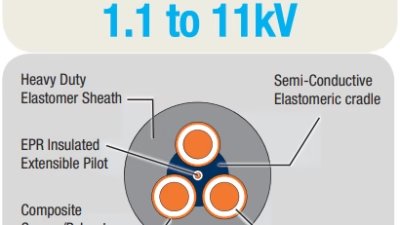
Mining Cable9 Min Read Electrical Systems Departmenton2026-01-16 Type 209 Mining Trailing Cable — 1.1kV to 11kV Type 209 cable construction follows a precisely engineered layer system designed to provide optimal electrical performance, mechanical… Discover More