Mining Cable9 Min Read Electrical Systems Departmenton2026-01-22 What is a Type 210 Cable, and Why is it Restricted to “Unrestricted” Areas or Hard Rock Mining? The Australian mining industry operates under one of the world's most rigorous regulatory frameworks for electrical equipment and cable… Discover More
Mining Cable5 Min Read Electrical Systems Departmenton2026-01-22 Type 455 Cables (3.3kV – 33kV): Technical Advantages of Interstitial Earth Conductor Design In medium and high-voltage mining cable engineering, the positioning of earth (grounding) conductors represents a critical design decision… Discover More
Mining Cable12 Min Read Electrical Systems Departmenton2026-01-22 How Do You Test the Integrity of the Semi-Conductive Screen in Type 440 Cables After a Crushing Incident? Comprehensive technical guide on testing semi-conductive screen integrity in AS/NZS 2802 Type 440 mining cables after crushing incidents.… Discover More
Mining Cable9 Min Read Electrical Systems Departmenton2026-01-22 How Often Should Insulation Resistance (IR) and Continuity Tests Be Performed on Trailing Cables Under Australian Mine Safety Regulations? Trailing and reeling cables pose an elevated safety risk in mining operations because a damaged trailing cable can lead to earthing faults and… Discover More
Mining Cable11 Min Read Electrical Systems Departmenton2026-01-22 How Do You Prevent “Birdcaging” in Large Cross-Section Type 455 Cables During Installation on Long-Travel Stackers? Birdcaging is a severe form of cable distortion that occurs when the individual strands or conductors of a cable unravel and expand outward,… Discover More
Mining Cable8 Min Read Electrical Systems Departmenton2026-01-21 What is the Difference in Earth Conductor Arrangement Between Type 450 (Distributed Earths) and Older Cable Designs? Type 450 cables, designed for voltage ratings from 3.3kV to 33kV, feature what engineers call a "distributed earth" arrangement. This modern… Discover More
Mining Cable9 Min Read Electrical Systems Departmenton2026-01-21 What is the “Sheath Reinforcement” Requirement in AS/NZS Cables, and How Does the Open-Weave Braid Improve Tear Resistance? 在澳大利亚和新西兰电缆标准中,护套加固是指在外护套内部或下方添加机械加强层。该加固专门设计用于增强电缆在安装和使用寿命期间对撕裂、切割、磨损和机械损伤的抵抗能力。这一要求对于矿山作业、卷筒系统和重型工业环境等苛刻应用中使用的电缆尤为重要。 Discover More
Mining Cable9 Min Read Electrical Systems Departmenton2026-01-21 What Are the Requirements for Type 409 Cables Used in Stacker-Reclaimer Systems? Type 409 cable, Type 409.1 cable, Type 409.3 cable, Type 409.6 cable, Type 409.11 cable, Type 409.22 cable, Type 440 cable, Type 450 cable,… Discover More
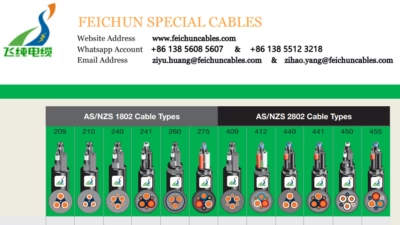
Mining Cable8 Min Read Electrical Systems Departmenton2026-01-19 AS/NZS 1802 vs AS/NZS 2802 What is the fundamental difference between AS/NZS 1802 and AS/NZS 2802 standards for mining cables? Discover More
Mining Cable10 Min Read Electrical Systems Departmenton2026-01-16 Understanding AS/NZS 1802:2003 & AS/NZS 2802:2000 Mining Cable Standards AS/NZS 1802:2003, AS/NZS 2802:2000, AS/NZS 1802, AS/NZS 2802, Type 241 mining cable, Type 240 mining cable, Type 245 mining cable, Type 440… Discover More